Thursday, 19 April 2012

Rupal Shah | Tautology of Memory


Rupal Shah | Tautology of Memory
Date: 23 April till 28 December 2012
Venue: Sherd Library, NUS Museum

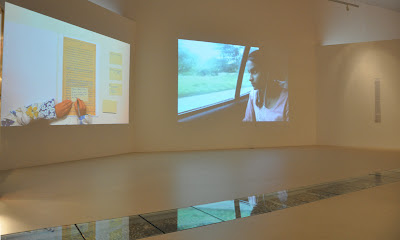
Tautology of Memory is a single channel video shot by artist Rupal Shah at the archaeological site of Ajanta in Western India.* Presented at the Sherd Library of the NUS Museum, the display is mediated through the multiplicity of voices that define an archaeological site, including the echoes of the tour-guide focusing on the murals and frescoes, constantly alluding to and reifying popular perceptions; the artist partializes this reification by employing her child’s exploration of the caves. Simultaneously, curatorial interventions first engage with colonial India’s foremost architectural historian, James Fergusson’s publication Rock-Cut Temples of India, a detailed and systematic documentation of Ajanta containing the photographs by another nineteenth century military-surveyor Robert Gill; and second with a 1927 newspaper report which applauds a decade-long documentation project undertaken by an art school student, Syed Ahmad at Ajanta. Evoking ironies, paradoxes and humour which descend on history and its sites, acutely choreographed between text, fragment and aesthetic, juxtapositions made playful with comments on colonial and postcolonial mappings of archaeological heritage, one is compelled to ask, does Ajanta lend itself for official surveys, archaeological scholarship, artistic projects or the heritage-making industry? What remains asserted, what has been reclaimed?

Friday, 13 April 2012

Curating Nation: Travelling Without Moving: Thai Contemporary Art Historicised, 20 April 2012, NUS MUSEUM


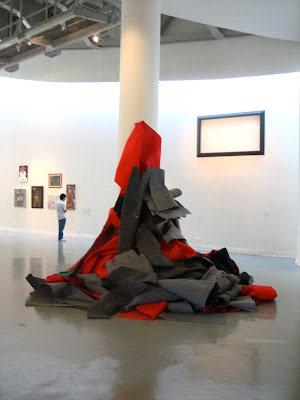
Arin Rungjang, Art as space for politics without space, 2010.
Synthetic carpets; dimensions variable. Installation view at
Bangkok Art and Culture Center. Courtesy the artist.

Date: 20 April 2012, Friday
Time: 6.30pm
Venue: NUS MUSEUM
Admission free. To register email: museum@nus.edu.sg or call 6516 8817 / 8429

Despite entrenched problems with its arts sector and years of political meltdown, Thailand manages to put more than its share of mercurial performers on the global contemporary art stage. A first generation achieved international visibility in the 1990s, amidst the crystallization of the 'contemporary' in Southeast Asia, and the region's discovery by the wider art world. Thai artists emerging more recently have tended to bypass this regional scene; and their work is marked in particular by a lack of national symbolic identifiers. Have Thai artists really shaken off the spectre of nation? Have they abandoned the pursuit of 'Thainess', or will it one day catch up with them? For all its global visibility, the study of

Thursday, 5 April 2012

Curating Nation: Guerrilla Archaeologists and the Singapore Story, 12 April 2012, Thursday, 6.30pm, NUS MUSEUM

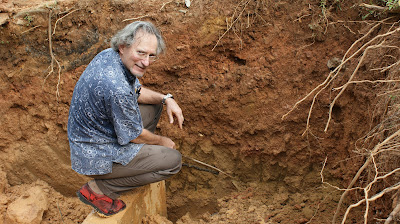
Prof. Miksic at the Spice Garden, Fort Canning


Date: 12 April 2012, Thursday
Time: 6.30pm
Venue: NUS MUSEUM

Free Admission.
To register, please email: museum@nus.edu.sg or call 6516 8817 / 8429

Most people think Singapore and archaeology are boring subjects, but the combination of the two can be exciting. Since Singapore has no laws covering archaeology, it is possible and sometimes necessary to go about the exploration for new sites in unorthodox ways. The term "underground" can mean something different in Singapore than it does in normal archaeological contexts!  In this talk Prof. John Miksic will provide an account of the history of archaeology in Singapore since 1984, and its connection with museums.

Speaker:
Prof. John Miksic grew up in western New York State, where he found stone arrowheads made by the Iroquois on his grandfather's farm. In 1967 he participated in his first archaeological expedition, to northern Canada to study Inuit. The next year he joined the Peace Corps and was sent to Malaysia, whereupon he was entranced by the archaeological potential of this region. He obtained his Ph.D. from Cornell in 1979 after studying an ancient port in northeast Sumatra. He lived in Bencoolen for two years, Yogyakarta for six years, and moved to Singapore in 1987. He teaches at the National University of Singapore, and heads the Archaeology Unit at ISEAS.

Wednesday, 4 April 2012

NUS Museum Walking Tour Series | Tracing the Symbolic-Geometric Orders of Colonial Singapore, Sat-21-April-12

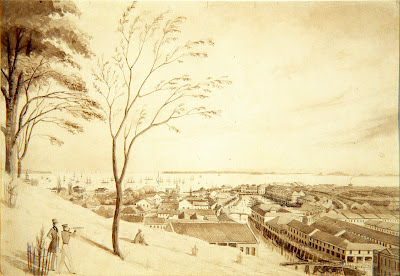
Charles Dyce, The Town and the Roadstead from Government Hill, 1842-47, Watercolour & ink on paper


Dates: 21 April  2012, Saturday
Time: 9.00am - 11.30am
Tour fee: $10 (for NUS students), $25 (for NUS staff and general public) Limited to 30 pax.

To register, email museum@nus.edu.sg or call 6516 8429.
*Please make tour fee payment by 13 April 2012 at NUS Museum upon receiving a confirmation email.

*Details on directions and meeting point will be sent upon confirmation and payment.

The tour will start at Raffles Terrace (on top of Fort Canning), the panopticon point of British colonial Singapore, then to explore the former colonial district and the legacy of George Drumgoole (Drumgold) Coleman (1795-1844) who played an important role in the planning, design and construction of public infrastructure and buildings in 19th century Singapore. The next part of the tour explores the Middle Road area which was known as “Little Japan” or “shita-machi” (downtown) during the Japanese Taisho era (1912-1926) and early part of Showa era (1926-1945) in Shonan-to (昭南島). The tour will end at the panopticon point of Japanese Shonan-to (the former Japanese Embassy) at Mt Emily Park, Wilkie Road.
The tour attempts to read the geometries which carry certain symbolic meanings from the city’s fabric, in relation to the two most important areas of colonial Singapore, such as the Masonic Pentagram (associated with Thomas Stamford Raffles, a Freemason) on the colonial district, and the Japanese Axis on Middle Road area.